
Last July, a family of four arrived at the Port Jefferson dock feeling a bit nervous because they didn’t know a “sinker” from a “swivel.” It’s a common story, and we see it every season! You want to have a blast with your kids, but the anxiety of doing something wrong on a public boat can feel like a heavy anchor. That’s why mastering basic fishing terms for beginners is the secret to a stress-free day on the Long Island Sound. You deserve to feel like an expert even if it’s your very first time holding a rod.
We agree that nobody should feel embarrassed while trying to make memories with their family. Our helpful crew is always there to guide you, but knowing the lingo helps you react faster when the porgies start biting! This guide will give you the confidence to understand exactly what the captain says so you can focus on the excitement of the catch. We’re breaking down the essential gear names and local Port Jeff slang you need for your 2026 summer adventures on the water.
Key Takeaways
- Step onto the boat with confidence by learning the roles of the “Angler” and the “Captain” before you even leave the dock.
- Navigate your gear like a pro by mastering essential fishing terms for beginners that cover everything from your rod to your terminal tackle.
- Learn the specific action lingo, such as “casting” and “the drop,” to help you get your line in the water the right way every time.
- Identify local Port Jefferson favorites like Fluke and Porgies so you will know exactly what is on the end of your line during the big catch.
- Discover how to use your new vocabulary to communicate with our helpful crew and make your first trip a stress-free family adventure.
The Absolute Basics: Who is Who on a Port Jefferson Fishing Boat?
Welcome to the Port Jefferson waterfront! Stepping onto a dock for the first time feels like entering a new world with its own unique language. Understanding these basic fishing terms for beginners ensures you feel like a pro before the boat even leaves the harbor. You aren’t just a passenger; you’re part of a maritime tradition that has thrived in the Long Island Sound for decades.
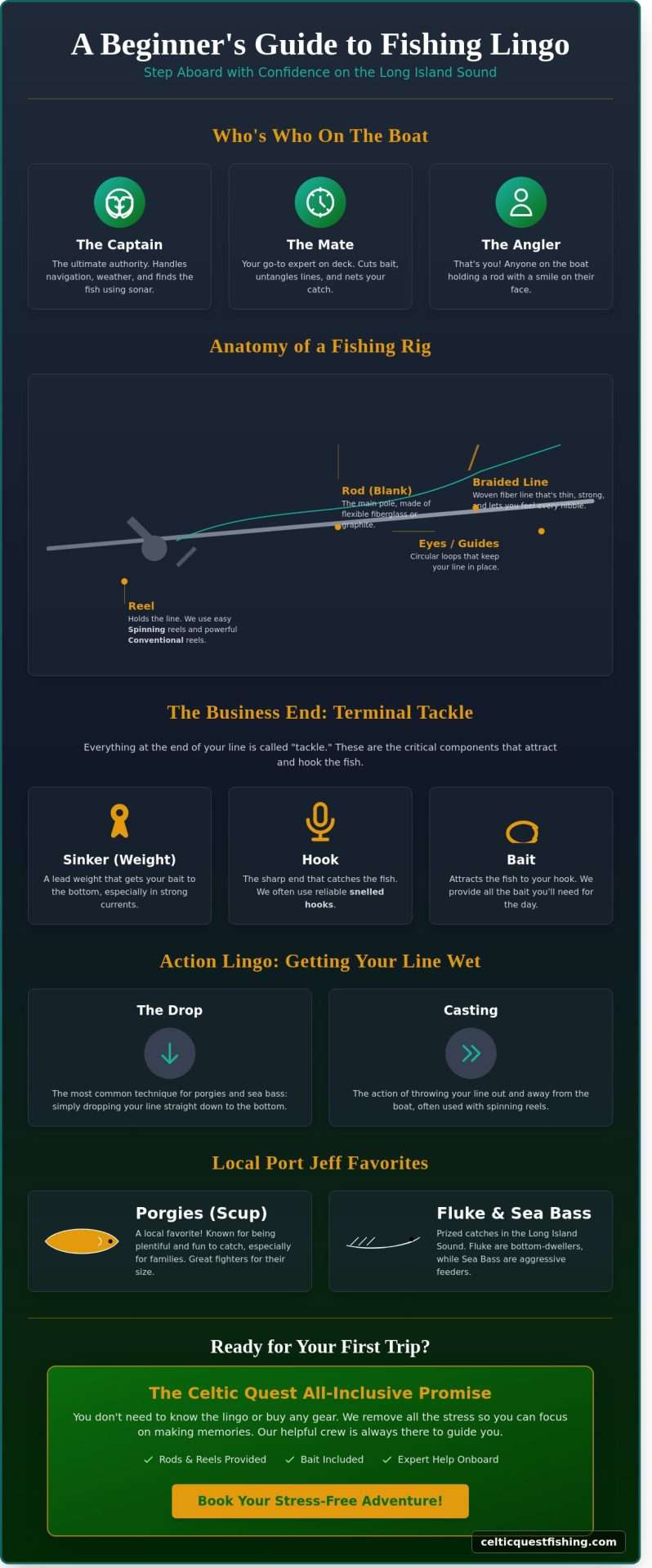
The Captain is the ultimate authority on the vessel. They handle the navigation, monitor the weather, and use advanced sonar to find exactly where the fish are hiding. While the Captain steers the ship, the Mate is your most valuable resource on the deck. They handle the messy tasks like cutting bait, untangling lines, and safely netting your catch. If you need help, just ask; they’re there to make your day easy and successful.
In Port Jefferson, you’ll often hear the term Party Boat or Open Boat. These terms refer to vessels that run on a set schedule where anyone can buy a single ticket and join the fun. It’s a communal way to fish that brings the whole neighborhood together on the water. For those who want a deeper dive into technical jargon, this Comprehensive Glossary of Fishery Terms offers a look at the wider world of maritime language.
The People You Will Meet
The Mate is the person you’ll interact with most. They’re the experts who show you how to drop your line and when to reel it back in. It’s also helpful to know the difference between a Charter and a Public Trip. A charter is a private booking for your specific group of friends or family. A public trip is open to everyone, making it a great way to meet fellow enthusiasts. An angler is anyone holding a rod with a smile.
The Celtic Quest Difference
We pride ourselves on having a helpful crew that simplifies the lingo for families and kids. You don’t need to study a manual before you arrive at the dock. Our all-inclusive promise means we provide the rods, the reels, and the bait for every guest. We’ve removed the barriers to entry so you can focus on the excitement of catching porgies and sea bass. Our goal is to make fishing terms for beginners feel natural while you create lasting memories on the Long Island Sound.
Essential Gear Terms: The Tools of the Trade
Ready to get your hands on some gear? Understanding fishing terms for beginners starts with your fishing rig. This is the combination of your rod and reel, and it’s your primary tool for a successful day on the water. Think of the rig as an extension of your arm. It lets you feel what is happening dozens of feet below the surface of the Long Island Sound. Our helpful crew will have everything ready for you, so you can focus on the fun!
Understanding Your Fishing Rig
The rod itself has two main parts you should know. The “blank” is the actual pole, usually made of flexible fiberglass or graphite. Along that blank, you will see circular loops called “eyes” or guides. These keep your line in place as it travels from the reel to the water. If you want to dive deeper into technical definitions, the NOAA Fisheries Glossary provides a massive list of marine terms used by professionals across the country.
On our Port Jefferson trips, we use two main types of reels. Spinning reels sit underneath the rod and are very easy for beginners to cast. Conventional reels sit on top of the rod and are perfect for the “drop and reel” style of fishing we do for porgies and sea bass. Your “line” is the string that connects you to the fish. We often use braided line on the Celtic Quest. This is a special type of line made of woven fibers that is much thinner and stronger than standard plastic line, allowing you to feel even the smallest nibble.
The Business End: Hooks and Weights
Everything attached to the end of your line is called tackle. Specifically, the items at the very tip are called terminal tackle. This includes your hooks, weights, and snaps. You don’t need to shop for anything before you arrive, because we provide all-inclusive gear for every guest on board! We love using snelled hooks for our guests. These are hooks that come with a short piece of line already professionally tied to them, making them incredibly reliable when a big fish pulls hard.
The way we arrange your hooks and weights is called “the rig.” In the Long Island Sound, the current can move quickly, sometimes reaching speeds of several knots. This is why “sinkers” are so vital. These lead weights pull your bait down to the bottom where the fish live. We also prioritize fresh bait over plastic lures. Using fresh clams or squid ensures that species like fluke and sea bass are attracted by scent and movement, which leads to many more catches for our guests! Our friendly crew is always nearby to help you refresh your bait so you never miss a beat.
Action Lingo: What to Do When the Fish Bite
Once you are on the deck of the Celtic Quest, the real excitement begins! Understanding these fishing terms for beginners will help you feel like a pro before the first porgy hits the deck. Fishing is a hands-on experience, and knowing how to react when you feel that first “tap-tap” on your line makes all the difference. Our helpful crew is always nearby to guide you, but mastering these basic moves will give you a head start on the fun.
- Casting: This is the act of using a flick of your wrist to send your bait away from the boat. On a crowded trip, you might just do a soft underhand toss to find a clear spot in the water.
- The Drop: This is the simplest way to get started. You simply release your line and let the weight carry your bait straight down to the bottom where the fish are hiding.
- Setting the Hook: When you feel a bite, you need to secure the fish. A quick, firm upward tug on the rod ensures the hook stays put. Don’t be shy; give it a confident snap!
- Reeling In: Once the hook is set, keep a steady pace as you turn the handle. Avoid jerky movements, as a smooth, consistent pull is the best way to bring your catch toward the boat.
- “Fish On!”: This is the universal shout of success on the Celtic Quest! It lets everyone know you’ve got something on the line, spreading the high-energy excitement across the entire deck.
Mastering the Motion
Success in the Long Island Sound often depends on how you move your rod. Jigging involves a rhythmic lifting and dropping of your lure to mimic a swimming baitfish. If the fish are hungry for a stationary meal, we stick to bottom fishing, where you let the bait rest right on the sandy floor. When the current in the Sound gets moving at 2 or 3 knots, you might “Scope Out.” This means your line is pulling away from the boat at an angle. To fix this, our crew will constantly remind you to “Keep your tip up!” Keeping the rod tip high helps maintain tension and prevents your line from tangling with your neighbor’s gear.
Landing the Catch
The moment your fish reaches the surface is the ultimate thrill. If you’ve hooked a big fluke or a heavy sea bass, yell “Net!” loud and clear. One of our mates will rush over with a long-handled net to scoop your prize safely out of the water. This is vital because lifting a heavy fish directly by the line can cause it to snap.
Once the fish is on board, we check if it’s a “Keeper” or a “Short.” NY State DEC regulations are very specific; for example, a porgy caught on a party boat must be at least 10.5 inches to go home with you. Anything smaller is a short and goes back into the water to grow for next year. If your keeper is especially large, you might even win the “Pool Fish.” This is our friendly daily competition where the angler with the heaviest catch of the day takes home a cash prize and bragging rights!
Local Flavor: Species and Conditions in Port Jefferson
Welcome to our favorite part of the world! When you step onto the deck of the Celtic Quest, you aren’t just a customer; you’re part of our fishing family. Understanding the local lingo helps you feel right at home while we explore the Long Island Sound. We simply call it “the Sound,” and it’s a massive, vibrant playground for anglers. To catch the best fish, our captains look for “structure.” This refers to anything on the sea floor like rocks, old wrecks, or reefs. These spots act like underwater apartments where fish congregate to hide and eat. Our helpful crew knows these spots by heart, ensuring you spend your time catching rather than searching!
If you’re learning fishing terms for beginners, you have to meet the Fluke. We often call them “flatfish” because they’re flat as a pancake and spend their time camouflaged on the sandy bottom. They are a Long Island staple and a blast to catch. For families and kids, we love targeting Porgies and Sea Bass. We call these “fast-action” fish because they’re hungry and plentiful. You won’t have to wait long for a tug on your line, which makes for plenty of smiles and great memories on the water.
Common Fish of the North Shore
The “kings” of the Sound are undoubtedly the Stripers, or Striped Bass. These fish can grow quite large and are highly prized for their strength. If you want a real battle, look out for “Blues” (Bluefish). They have a reputation for being fierce “fighters.” When a Bluefish grabs your bait, get ready for an exciting tug-of-war! To plan your trip around these specific catches, take a look at our Port Jefferson fishing season guide for the best times to visit.
Water and Weather Terms
The water conditions in Port Jefferson harbor tell us a lot about the day ahead. On a calm morning, the surface might look like “Glass,” meaning it’s perfectly smooth. If there’s a light wind, you’ll see “Chop,” which refers to small, bumpy waves. You’ll also want to know about “Slack Tide.” This is the short window when the tide is switching directions and the water stops moving. It’s a great time to grab a snack before the current picks back up! Finally, the water near the shore is often “Brackish.” This is just a fancy way to say it’s a mix of fresh water from the land and salt water from the sea.
We make everything easy by providing all the gear and bait you need for your trip. Our goal is to keep things stress-free so you can focus on the fun! Learning these fishing terms for beginners is the first step toward becoming a regular on the docks.
Ready for Your First Trip? Putting Lingo into Action
Now that you’ve mastered these fishing terms for beginners, it’s time to step onto the deck and put that knowledge to work. Don’t feel like you need to be an expert on day one. In fact, the most useful phrase you can ever say to our crew is simply, “I am a beginner.” This isn’t a sign of weakness; it’s a signal to our mates that you’re ready for some extra attention. Our team has decades of experience guiding new anglers, and we love helping guests land their very first porgy or sea bass.
The heart of the action on the Celtic Quest is the bait station. This is where the magic happens. It’s the central hub where our crew prepares fresh bait and offers quick pointers on your technique. You’ll find that the atmosphere is more like a backyard barbecue than a high-pressure competition. We prioritize your comfort and success above everything else, making sure your buckets stay full and your smiles stay wide.
Communication with the Crew
When you’re out on the water, clear communication keeps the fun moving. If your line gets crossed with a neighbor, don’t sweat it. Just call out for a mate and tell them you have a “Tangle” or a “Bird’s Nest.” These things happen to everyone, even the pros who have been fishing for 30 years. Our crew can untie a knot faster than you can say “fish on!”
If you want to sound like you’ve been doing this for a while, ask the mate, “What’s the depth?” Knowing if we are in 20 feet or 40 feet of water helps you gauge how much line to let out. It’s a smart way to stay engaged with the process. If you’re planning a big outing, you should also check out our group fishing tips to ensure your whole crew is ready for the adventure.
Booking Your Port Jefferson Adventure
Port Jefferson is the perfect place to learn the ropes. The waters are beautiful, and the local community is incredibly welcoming. We make things incredibly easy with our “Everything Included” public trips. You don’t need to own a single piece of gear. We provide the rods, the reels, the tackle, and the bait. You just show up ready for a great time.
At the end of the day, fishing is about the memories you make with your friends and family, not just the words you use. Whether you’re catching fluke or just enjoying the salt air, the experience is what sticks with you. Before you head to the dock, make sure you’ve reviewed our first time fishing trip Port Jefferson checklist so you know exactly what to expect and how to prepare. Our 5-star rated crew is here to make sure every moment is stress-free and exciting. Ready to get started?
Grab Your Gear and Get on the Water!
Now that you’ve mastered the essential fishing terms for beginners, you’re ready to step onto the dock with total confidence. You know exactly who’s who on the boat and how to use the gear like a local pro. From understanding the “bite” to identifying Port Jefferson species like fluke and sea bass, you have the knowledge to make your first trip a massive success. Since 2002, our family-owned team has welcomed everyone from first-timers to seasoned experts onto the Long Island Sound. We love seeing new faces discover the thrill of the catch!
We believe fishing should be about making memories, not stressing over technical details. That’s why we take care of the hard work for you. Our USCG Certified vessels meet the highest safety standards, and we provide all the gear, bait, and tackle you’ll need for the day. You don’t need to bring anything but your enthusiasm. Our friendly crew is excited to help you bait your hook and celebrate every fish that comes over the rail. To make sure you arrive fully prepared, take a look at our ultimate checklist for your first time fishing trip in Port Jefferson before you head out. It’s time to turn that new lingo into real action on the waves.
Join us for a Full Day Public Fishing Trip in Port Jefferson!
We can’t wait to see you on the deck for a day of sunshine, salt air, and plenty of tight lines!
Frequently Asked Questions
What is a “bird’s nest” in fishing?
A bird’s nest is a tangled mess of fishing line that bunches up on your reel, usually caused by a backlash during a cast. It looks just like a real nest made of line! Don’t let it ruin your day because our helpful crew can untangle most messes in under 2 minutes. We’re here to keep you fishing and making memories without the stress of gear malfunctions.
What does it mean when the captain says “lines up”?
When the Captain calls out “lines up,” it means it’s time to reel in your gear and prepare for the boat to move to a new spot. This usually happens when we’ve finished a drift or are heading to a fresh area where the porgies and sea bass are biting better. It’s a signal for everyone to clear the water quickly so we can get you back on the fish even faster!
What is the difference between a “keeper” and a “short”?
A “keeper” is a fish that meets the legal size requirements set by New York State, while a “short” is a fish that’s too small and must be released. For example, a fluke must be at least 19 inches long to keep during the 2024 season. Learning these fishing terms for beginners ensures you follow local regulations. Our crew measures every catch with precision to make sure your cooler only has legal, delicious fish.
What does “chumming” mean and do you do it on Celtic Quest?
Chumming is the process of throwing ground-up bait into the water to create a scent trail that attracts hungry fish to the boat. On the Celtic Quest, we use this technique frequently to bring schools of fish right to your hook. It’s a highly effective way to increase the action on the deck. Our team handles all the messy work, so you just focus on the excitement of the catch!
What is a “sinker” and why are there different sizes?
A sinker is a lead weight attached to your line that pulls your bait down to the underwater habitat where fish live. We use different sizes, ranging from 2 ounces to 16 ounces, depending on how fast the current is moving in the Long Island Sound. Heavier weights keep your line straight down even when the tide is pulling hard. Our crew provides the perfect weight for every condition!
What does “bag limit” mean for Port Jefferson fishing?
A bag limit is the maximum number of a specific fish species that one person is legally allowed to keep in a single day. In Port Jefferson, these limits are strictly managed by the DEC to protect our local waters. For instance, the 2024 limit for scup is 30 fish per person for most of the year. We’ll make sure you stay within these limits while filling your bucket!
What is a “rig” and do I need to make my own?
A rig is the specific arrangement of hooks, leaders, and swivels attached to the end of your fishing line. You don’t need to worry about making your own because we provide custom-tied rigs that are proven to catch fish in our local area. These setups are designed for ease of use, making them essential fishing terms for beginners to understand. Just step on board and our friendly crew will have you ready!
What does “bottom fishing” mean?
Bottom fishing is a technique where you drop your weighted bait all the way to the seafloor to target species that live near the ground. This is our specialty at Celtic Quest, as we target popular locals like fluke, sea bass, and porgies. It’s a very accessible style of fishing that’s perfect for families. You’ll feel a distinct thump on your line when a fish grabs the bait off the bottom!
Ready to get out on the water? book your Port Jefferson fishing trip or call us at (631) 928-3926. We’ll see you at the dock.
